
Everything takes so much effort
Tight muscles, held breath and movements that cost a lot of energy. Rest can be hard to find, even when lying down.
Home / Who we help / Cerebral palsy
Cerebral palsy, children and adults
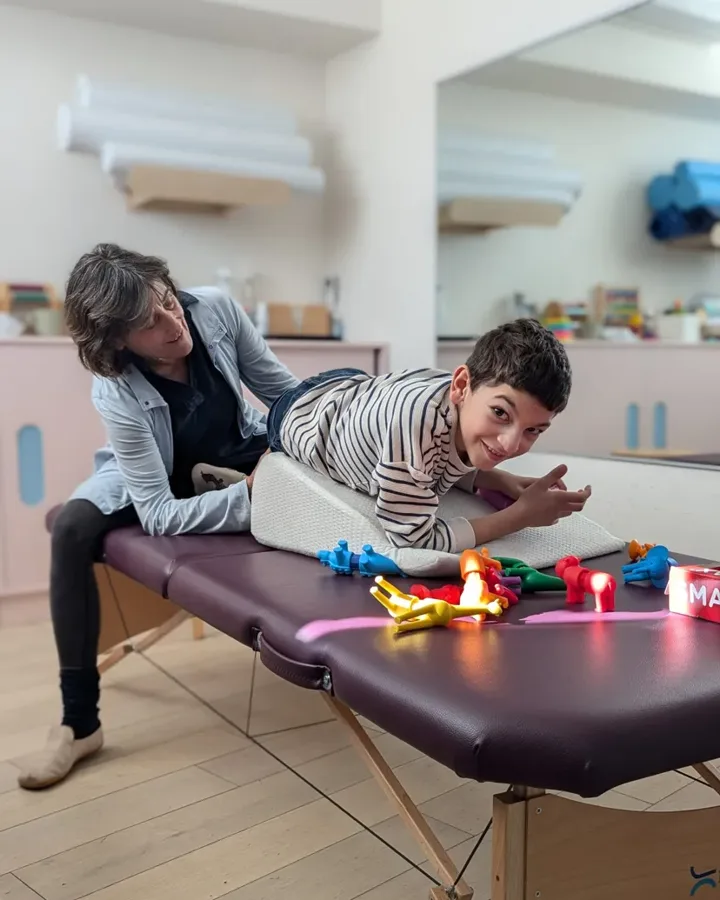
Cerebral palsy begins in the brain, so that is where we start. Through slow, connected touch and small, varied movements, we help the brain notice new possibilities and organise the whole body with more comfort and ease. We work with babies, children and adults, and we start from what is already possible.
You are not alone
Most families who contact us have already worked hard for years. These are the things we hear most often.
Tight muscles, held breath and movements that cost a lot of energy. Rest can be hard to find, even when lying down.
Months or years of exercises, and the gains have levelled off. Repeating the same movements is not producing anything new.
Pain, reflux, restless nights or a child who struggles to settle anywhere but in your arms.
Predictions built on a diagnosis, rather than on what your child is actually showing you.
How we work
Most approaches to cerebral palsy work on the muscles: stretching what is tight, strengthening what is weak, repeating a movement until it sticks. But the patterns of tightness and effort are organised by the brain. When the brain does not have a clear picture of the body, it holds on.
Many parents have spent years doing exercise programmes at home, often on autopilot because there is so much else to manage. Movement done mechanically gives the brain very little to learn from. What makes the difference is connection: slowing down, paying attention to how a movement feels and meeting your child where they are. That quality of connection is what the 9 Essentials describe, and it is something parents and carers can learn to bring into everyday life.
In an ABM NeuroMovement lesson, the practitioner meets the person where they are. Using slow, gentle touch and many small variations of movement, they give the brain information it can actually use. Once the brain notices a difference, it can learn from it, and find easier ways to organise the whole body. Nothing is forced, and nobody is asked to do what they cannot yet do.
Comfort is often the first thing to change, and it matters because it is a foundation. A body that is less tense and less tired has more capacity to learn, and each change becomes a building block for the next. People feel it themselves, and those around them see it in how they rest, sleep and engage, and then in how they move. This is true at any age, from babies to adults.
Every person is different, and we cannot promise specific outcomes. We will always tell you honestly what we see.
“I literally saw my child come to life. She was so alert and aware during and after her first lesson.”Abi, mother of Annabelle, who has dystonic cerebral palsy
What to expect
Many parents have seen a child placed into standing, or balanced on a ball. Those moments look like big progress, and it is natural to want them. But when a child is held in a position their brain cannot yet organise, they often hold themselves up with effort and extra tone. That can increase tightness, and it rarely carries over into everyday life.
In a lesson we work on what sits underneath: how the head, spine, ribs and pelvis organise together. It can look subtle from the outside. The changes parents tell us about show up at home: a softer body, easier rest, and new movements the child finds and owns for themselves, including sitting, standing and walking when the brain is ready for them.
We cannot promise specific outcomes. What we can promise is that we will explain what we are doing and why, and show you what we are seeing as it happens.
Watch
Next dates
Intensives usually run from Wednesday to Sunday, though the format sometimes differs. These are the dates for our visiting international practitioners, and for weekend lessons at our centre. Places are limited, so families usually book a few weeks ahead.
New dates are being arranged. Ask us and we will tell you what is coming up.
Getting started
The enquiry form takes about three minutes. It helps us prepare, so your call is about you rather than general questions.
Around 20 minutes. We talk through what you have tried and what you are hoping for, and share fees and availability. If we do not think we can help, we will say so.
Most people start with an intensive of 6 to 10 one to one lessons over a few days. Intensives start from £450 with our UK practitioners, and from £810 with our visiting international practitioners.
Common questions
There is no lower or upper age limit. We work with babies from a few weeks old, with children and teenagers, and with adults. The brain keeps its capacity to learn throughout life.
Many families tell us that tone, tension and involuntary movement ease as the brain finds better organisation. We cannot promise a specific outcome. We will tell you honestly what we see after the first lessons.
Most families start with an intensive of 6 to 10 lessons over three to five days. The brain builds on what it learns, so families who continue month by month, usually over three months or more, tend to see the deepest change. Many of our longest standing families have cerebral palsy.
During an intensive we usually recommend pausing other therapies, so the brain has space to take in what it is learning and you can see clearly what is helping. Anything medical, and anything your medical team has prescribed, should always continue.
Received
We have also sent you an email with a copy of the next steps.
Would you like to choose a time now? Book a 20 minute call with us at a time that suits you.
Book a callIf anything is urgent, call us on 07873 990399.